Across the UK, water and utility providers are facing increasing pressure to modernise aging infrastructure, improve operational efficiency, and meet strict environmental regulations. As a result, the demand for innovative digital solutions in water and wastewater projects continues to grow. From treatment works and pumping stations to large-scale infrastructure upgrades, accurate planning and efficient coordination have become essential for successful project delivery.
This is where Wastewater Engineering plays a critical role. By combining advanced surveying technologies, Building Information Modelling (BIM), and multidisciplinary engineering expertise, organisations can reduce risk, improve collaboration, and streamline construction processes. Modern engineering projects now rely heavily on precise data capture, 3D modelling, and digital coordination to minimise delays and support long-term asset performance.
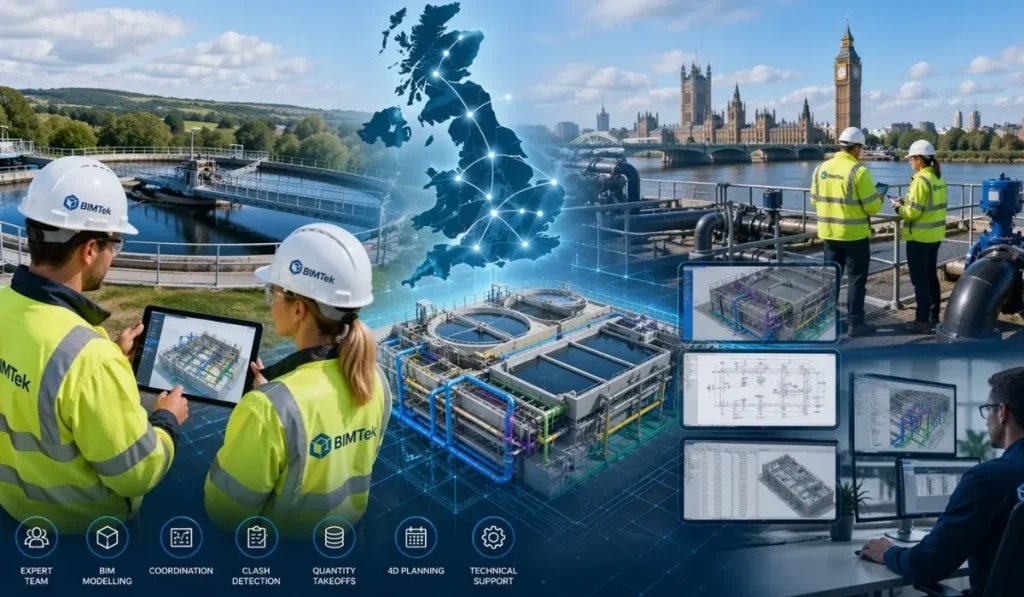
BIMTek supports water and wastewater engineering projects across the UK with a range of specialist services, including 3D laser scanning, drone surveying, BIM coordination, mechanical and electrical design, and digital engineering solutions. Through innovative workflows and practical engineering expertise, BIMTek helps clients improve project efficiency, reduce installation challenges, and deliver infrastructure projects with greater accuracy and confidence.
Understanding the Challenges in Wastewater Engineering
The UK water industry is currently undergoing significant transformation as utility providers work to improve infrastructure resilience, operational efficiency, and environmental sustainability. However, delivering successful Wastewater Engineering projects comes with several technical and logistical challenges. From outdated infrastructure to increasingly complex regulatory requirements, engineering teams must adopt smarter and more efficient delivery methods to keep projects on track.
Aging Infrastructure Across the UK
Many water treatment facilities, pumping stations, and pipeline networks across the UK were built decades ago and now require major upgrades or complete refurbishment. As populations grow and demand on utilities increases, existing systems are often pushed beyond their original capacity. Consequently, water companies must modernise infrastructure while ensuring minimal disruption to ongoing operations.
In addition, older facilities frequently lack accurate as-built documentation, making refurbishment and expansion projects more difficult. Without precise site data, clashes, delays, and costly rework can occur during construction and installation phases.
Environmental and Regulatory Pressures
Environmental compliance is another major challenge facing the sector. Water companies are under increasing pressure to reduce emissions, improve water quality, and meet strict sustainability targets established by UK regulators. Therefore, engineering solutions must not only improve operational performance but also support long-term environmental goals.
Furthermore, wastewater facilities often operate continuously, which means upgrades and maintenance work must be carefully planned to minimise downtime and avoid service interruptions. This requires detailed coordination between design teams, contractors, and operational stakeholders.
Complex Site Conditions and Safety Requirements
Many water and wastewater sites contain confined spaces, hazardous environments, and operational equipment that can make traditional surveying and inspection methods difficult. Access limitations, health and safety concerns, and live operational conditions can all impact project timelines and increase risk.
As a result, digital technologies such as 3D laser scanning, drone surveying, and BIM coordination have become increasingly valuable within Wastewater Engineering. These solutions allow engineering teams to capture highly accurate site data safely and efficiently while reducing the need for intrusive site activities.
BIMTek’s Core Services for Water and Wastewater Engineering
Modern infrastructure projects require far more than traditional engineering methods. To deliver successful outcomes in today’s utility sector, projects depend on accurate data capture, digital coordination, and multidisciplinary collaboration. BIMTek provides a comprehensive range of services designed to support efficient and reliable Wastewater Engineering projects across the UK.
By combining advanced surveying technologies with practical engineering expertise, BIMTek helps clients improve planning accuracy, reduce installation risks, and streamline project delivery from concept through to construction.
Advanced 3D Laser Scanning and LiDAR Surveys
Accurate site information is essential for any infrastructure upgrade or refurbishment project. BIMTek uses advanced 3D laser scanning and LiDAR technology to capture highly detailed data from operational treatment works, pumping stations, and complex industrial environments.
Unlike traditional surveying methods, laser scanning is non-intrusive and significantly reduces the amount of time required on-site. Additionally, it allows engineers to safely capture precise measurements without physical contact with machinery or structures. Once processed, the scans are combined into highly accurate 3D point clouds that support modelling, design coordination, and clash detection.
As a result, project teams can make more informed decisions earlier in the design process while reducing the risk of costly rework during installation.
Drone Surveying and Aerial Mapping
In many water and wastewater facilities, accessing elevated or restricted areas can be both challenging and time-consuming. BIMTek addresses this issue through professional drone surveying and aerial mapping services.
Using drone-mounted cameras, LiDAR scanners, and photogrammetry technology, BIMTek can quickly capture detailed aerial data across large operational sites. This approach improves safety while reducing disruption to ongoing operations. Furthermore, drone surveys provide valuable visual data that can support inspections, planning, and asset management activities.
Photogrammetry outputs can also be converted into 3D point clouds and mesh models, allowing engineering teams to visualise existing infrastructure more effectively during project development.
BIM Modelling and Digital Coordination
Building Information Modelling plays a critical role in modern Wastewater Engineering projects. BIMTek develops detailed 3D models that allow multidisciplinary teams to coordinate layouts, identify clashes, and optimise installation sequences before work begins on-site.
Through digital coordination, stakeholders gain improved visibility across mechanical, electrical, civil, and structural elements of a project. Consequently, communication becomes more efficient, installation risks are reduced, and project timelines can be better controlled.
In addition, BIM workflows support offsite manufacturing and modular construction strategies, which can further improve delivery efficiency across complex infrastructure schemes.
Mechanical, Electrical, and Civil Engineering Support
Alongside surveying and digital modelling services, BIMTek also provides engineering support for a wide range of utility infrastructure projects. This includes mechanical layouts, pipework design, structural detailing, reinforced concrete solutions, and electrical coordination.
Because these services are delivered through an integrated workflow, clients benefit from improved collaboration between disciplines and faster project turnaround times. This integrated approach is particularly valuable for water and wastewater facilities where operational continuity and installation sequencing are critical to project success.
How BIMTek Improves Project Efficiency
Efficiency is one of the most important factors in successful Wastewater Engineering projects. With tight delivery schedules, operational constraints, and increasing regulatory demands, utility providers require solutions that reduce delays while maintaining high levels of accuracy and safety. BIMTek supports this goal by combining digital engineering technologies with practical project coordination strategies that improve workflows across every stage of delivery.
From early surveying and modelling through to installation planning and construction support, BIMTek helps project teams work smarter, minimise disruption, and achieve better outcomes.
Faster Decision-Making Through Digital Engineering
Modern infrastructure projects generate large amounts of technical information that must be shared between engineers, contractors, consultants, and stakeholders. BIMTek simplifies this process through digital engineering workflows that improve visibility and collaboration throughout the project lifecycle.
Using 3D models, point cloud data, and coordinated layouts, project teams can quickly understand existing site conditions and evaluate design options with greater confidence. In addition, digital visualisation tools make it easier to communicate complex engineering concepts to both technical and non-technical stakeholders.
As a result, approvals can often be achieved more efficiently, design changes can be managed earlier, and project teams are better equipped to avoid unexpected construction challenges.
Reduced Costs and Installation Risks
One of the biggest advantages of accurate surveying and BIM coordination is the ability to identify potential issues before construction begins. BIMTek’s use of 3D laser scanning and coordinated modelling allows engineering teams to detect clashes, optimise layouts, and validate installation sequences in advance.
Consequently, projects experience fewer on-site modifications, reduced material waste, and lower rework costs. This proactive approach also improves scheduling accuracy and helps contractors better manage installation activities within operational environments.
Furthermore, BIMTek’s ability to adapt standard design solutions where appropriate can shorten design timelines and reduce overall project expenditure without compromising quality or performance.
Improved Site Safety and Accessibility
Safety remains a major priority across all water and wastewater infrastructure projects. Many facilities contain confined spaces, hazardous areas, elevated structures, and live operational equipment that can create significant risks during surveys and inspections.
BIMTek helps reduce these risks by using non-intrusive surveying methods such as LiDAR scanning and drone technology. These solutions minimise the need for physical access while still delivering highly accurate site data. Therefore, project teams can safely inspect difficult-to-access areas with reduced disruption to operational facilities.
Additionally, accurate digital models allow contractors to plan installation activities more effectively, improving access arrangements and reducing the likelihood of safety issues during construction phases.
Better Coordination Across Project Teams
Successful Wastewater Engineering projects depend heavily on collaboration between multiple disciplines, including civil, structural, mechanical, and electrical engineering teams. BIMTek’s integrated approach supports seamless coordination across all project stakeholders.
Through shared BIM environments and coordinated digital models, teams can review layouts, monitor interfaces, and resolve conflicts before work reaches the construction stage. This not only improves communication but also accelerates project delivery by reducing delays caused by design inconsistencies or incomplete information.
As infrastructure projects become increasingly complex, this level of coordination is essential for maintaining programme efficiency and ensuring long-term operational reliability.
Real-World Water and Wastewater Engineering Projects
Practical experience is essential in delivering successful infrastructure solutions. Across the UK, BIMTek has supported a variety of water and Wastewater Engineering projects through advanced surveying, BIM coordination, and multidisciplinary engineering services. These projects demonstrate how digital engineering technologies can improve efficiency, reduce risk, and simplify complex installations within operational environments.
By combining accurate site data with collaborative design workflows, BIMTek helps utility providers achieve better project outcomes while maintaining operational continuity.
Bourton Water Treatment Works Refit
The Bourton Water Treatment Works project required detailed engineering coordination within an active operational facility. BIMTek supported the scheme through 3D laser scanning, point cloud generation, and BIM modelling to provide accurate existing site information before installation activities began.
Using coordinated digital models, the project team was able to optimise layouts for pumps, pipework, access platforms, and associated infrastructure. This early-stage coordination reduced the likelihood of clashes during installation and improved construction planning efficiency.
In addition, the use of accurate survey data allowed stakeholders to visualise the project more effectively, helping streamline communication and improve decision-making throughout the design process.
East Quay Sewage Pumping Station Upgrade
Infrastructure upgrades within operational pumping stations often present significant access and sequencing challenges. At East Quay Sewage Pumping Station, BIMTek provided engineering support to assist with layout redesigns, digital coordination, and project planning activities.
The project involved improving operational access while integrating new infrastructure within an existing constrained environment. Through BIM coordination and accurate digital modelling, the team was able to identify potential installation conflicts early and optimise the placement of mechanical and structural elements.
Consequently, the project benefited from improved installation efficiency, reduced disruption to site operations, and better coordination between engineering disciplines.
Cheddar Water Treatment Works Electrochlorination Design
For the Cheddar Water Treatment Works project, BIMTek supported the development of an electrochlorination system upgrade through detailed digital engineering workflows. The project required careful planning to integrate new equipment within a live operational environment while maintaining safe access and efficient installation sequencing.
Using BIM coordination and 3D modelling, BIMTek helped evaluate design options, optimise equipment layouts, and improve constructability across the site. Furthermore, the use of accurate digital models allowed stakeholders to review the proposed installation in detail before construction activities commenced.
This proactive approach reduced project risk, improved collaboration between teams, and supported smoother delivery during later project phases.
Early Enabling Works for AMP8 Infrastructure Projects
BIMTek has also supported early enabling works strategies designed to accelerate wider AMP8 programme delivery. By adapting standard design solutions and using coordinated 3D modelling, projects can move forward more efficiently while reducing future installation risks.
For example, early construction of slabs, bunds, and utility infrastructure allows critical equipment installations to begin before larger construction packages commence. This approach improves sequencing flexibility, shortens programme durations, and supports more efficient procurement and construction planning.
As water infrastructure projects continue to increase in complexity, these examples demonstrate the growing importance of digital engineering and integrated project coordination within modern Wastewater Engineering delivery.
The Role of BIM in the Future of Wastewater Engineering
As the UK water sector continues to modernise, digital technologies are becoming increasingly important in the planning, delivery, and management of infrastructure projects. Building Information Modelling (BIM) is now recognised as a key driver of innovation within Wastewater Engineering, helping organisations improve collaboration, reduce risk, and create more sustainable infrastructure solutions.
By integrating accurate data, intelligent modelling, and real-time coordination, BIM enables project teams to make better decisions throughout the entire asset lifecycle. Consequently, utility providers can deliver projects more efficiently while improving long-term operational performance.
Smart Infrastructure and Data-Driven Planning
The future of water infrastructure relies heavily on accurate and accessible project data. BIM allows engineers, contractors, and operators to work from a shared digital environment where information can be updated, reviewed, and coordinated in real time.
This data-driven approach improves project planning by allowing teams to visualise infrastructure before construction begins. In addition, BIM models support asset management by storing detailed information about equipment, layouts, maintenance schedules, and operational systems.
As a result, water companies can improve maintenance planning, reduce unexpected failures, and make more informed investment decisions over the long term.
Sustainability and Carbon Reduction
Sustainability has become a major priority across all areas of infrastructure development. Within Wastewater Engineering, BIM supports more environmentally responsible delivery methods by improving design accuracy and reducing unnecessary waste.
For example, coordinated digital models help optimise material quantities, minimise construction errors, and reduce the need for rework during installation. Furthermore, BIM workflows support offsite manufacturing and modular construction approaches, which can reduce transportation requirements, shorten construction programmes, and lower overall carbon emissions.
Through improved planning and coordination, engineering teams can also reduce disruption to operational facilities and surrounding environments, supporting broader sustainability goals across the water sector.
Integration with Emerging Technologies
BIM continues to evolve alongside other advanced digital technologies that are transforming infrastructure delivery. Increasingly, Wastewater Engineering projects are integrating BIM with technologies such as digital twins, drone surveying, laser scanning, and augmented reality.
Digital twins, for example, allow utility providers to create virtual representations of operational assets that can be monitored and updated in real time. This enables better performance analysis, predictive maintenance, and operational planning.
Similarly, drone surveys and LiDAR scanning technologies provide highly accurate site data that can be directly integrated into BIM models. This creates a more efficient workflow between surveying, design, and construction teams while improving project accuracy.
Augmented reality tools are also beginning to support installation planning and maintenance activities by allowing teams to visualise infrastructure layouts within real-world environments before physical work begins.
Supporting Long-Term Infrastructure Resilience
As AMP8 and future infrastructure investment programmes progress across the UK, BIM will continue to play a critical role in delivering resilient and future-ready utility systems. Engineering teams must now balance operational efficiency, sustainability, safety, and regulatory compliance within increasingly complex project environments.
By adopting BIM-driven workflows and advanced digital engineering solutions, organisations can improve collaboration, accelerate delivery programmes, and better manage infrastructure assets over their operational lifespan.
Companies such as BIMTek are helping drive this transformation by providing innovative surveying, modelling, and engineering solutions that support smarter and more efficient Wastewater Engineering projects across the UK.
Why UK Utilities Choose BIMTek
Delivering successful water infrastructure projects requires more than technical expertise alone. Utility providers need reliable engineering partners who understand the operational, regulatory, and logistical challenges involved in modern Wastewater Engineering. Across the UK, BIMTek supports clients through a combination of advanced digital technologies, multidisciplinary engineering knowledge, and practical project delivery experience.
By focusing on accuracy, collaboration, and innovation, BIMTek helps organisations improve project efficiency while reducing risk across every stage of development.
Extensive Experience in Water and Wastewater Engineering
BIMTek has worked across a wide range of water and wastewater infrastructure projects, including treatment works upgrades, pumping station refurbishments, utility coordination, and enabling works packages. This industry experience allows the team to understand the unique demands of operational utility environments and develop solutions tailored to complex project requirements.
Furthermore, BIMTek’s experience with both new-build and refurbishment projects enables efficient support for projects at different stages of the asset lifecycle.
Integrated Surveying and Engineering Expertise
One of BIMTek’s key strengths is its integrated approach to surveying, BIM coordination, and engineering design. Rather than relying on disconnected workflows, BIMTek combines multiple services within a coordinated digital environment.
This includes:
- 3D laser scanning and LiDAR surveys
- Drone surveying and photogrammetry
- BIM modelling and clash detection
- Mechanical, electrical, and structural coordination
- Point cloud processing and digital visualisation
As a result, clients benefit from improved communication, faster project turnaround times, and greater consistency throughout the delivery process.
Focus on Accuracy and Digital Innovation
Accurate site information is critical within Wastewater Engineering, especially when working within live operational facilities. BIMTek uses advanced digital technologies to provide highly detailed and reliable data that supports better planning and safer installation activities.
By continuously adopting new surveying and modelling technologies, BIMTek helps clients improve project efficiency while reducing the likelihood of costly site issues. In addition, digital workflows allow stakeholders to visualise projects more effectively and make informed decisions earlier in the design phase.
This focus on innovation supports faster approvals, improved coordination, and more predictable project outcomes.
Flexible Solutions for Complex Infrastructure Projects
Every infrastructure project presents different operational challenges, environmental constraints, and delivery requirements. BIMTek works closely with clients to develop practical engineering solutions that align with project objectives, budgets, and construction programmes.
Whether supporting small-scale refurbishment works or large AMP8 infrastructure schemes, BIMTek provides scalable services that adapt to changing project needs. Additionally, the use of standard design approaches and coordinated BIM workflows can help accelerate delivery while maintaining high engineering standards.
Supporting Long-Term Project Success
Beyond project delivery, BIMTek’s digital engineering solutions also support long-term asset management and operational efficiency. Accurate BIM models, point cloud data, and coordinated layouts provide valuable information that can continue to support maintenance, upgrades, and future expansion works.
As the UK water sector continues to evolve, engineering partners that combine technical expertise with digital innovation will play an increasingly important role in shaping resilient infrastructure systems. BIMTek continues to support this transformation by delivering practical, efficient, and future-focused solutions for water and Wastewater Engineering projects across the UK.
Frequently Asked Questions (FAQs)
What is Wastewater Engineering?
Wastewater Engineering involves the planning, design, construction, and maintenance of systems used to manage wastewater and sewage treatment processes. This includes treatment plants, pumping stations, pipelines, drainage infrastructure, and associated utility systems. The primary goal is to ensure wastewater is safely collected, treated, and returned to the environment in compliance with environmental regulations.
Modern wastewater projects also focus heavily on sustainability, operational efficiency, and infrastructure resilience. As a result, digital technologies such as BIM modelling, laser scanning, and drone surveying are becoming increasingly important within the industry.
How does BIM improve water and wastewater infrastructure projects?
Building Information Modelling (BIM) improves infrastructure projects by creating detailed digital representations of assets before construction begins. These models allow engineering teams to coordinate layouts, identify clashes, and optimise installation sequencing more effectively.
In addition, BIM improves communication between stakeholders by providing accurate visualisation and shared project data. This helps reduce design errors, minimise rework, and improve overall project efficiency.
For water and wastewater facilities, BIM is particularly valuable because it supports work within operational environments where installation planning and safety coordination are essential.
Why is 3D laser scanning important in wastewater projects?
3D laser scanning allows engineering teams to capture highly accurate measurements of existing infrastructure quickly and safely. The technology creates detailed point cloud data that can be used for BIM modelling, design coordination, and asset analysis.
Within Wastewater Engineering, laser scanning is especially useful because many facilities contain confined spaces, complex pipework, and operational equipment that are difficult to measure using traditional survey methods.
Additionally, laser scanning reduces the amount of time required on-site and helps minimise disruption to operational facilities.
What are the benefits of drone surveying for utility infrastructure?
Drone surveying provides a fast, safe, and cost-effective way to inspect and survey large or difficult-to-access infrastructure sites. Drones equipped with high-resolution cameras, LiDAR sensors, and photogrammetry technology can collect detailed aerial data without requiring extensive manual access.
This approach improves safety while reducing disruption to ongoing operations. Drone surveys are commonly used for:
- Asset inspections
- Roof and structural surveys
- Topographical mapping
- Progress monitoring
- 3D point cloud generation
As utility infrastructure projects become more complex, drone technology continues to improve project efficiency and data accuracy.
How does BIMTek support operational treatment facilities?
BIMTek supports operational facilities by using non-intrusive surveying methods, coordinated BIM workflows, and detailed engineering planning to minimise disruption during project delivery.
Through technologies such as LiDAR scanning and drone surveying, BIMTek can safely capture accurate site data without requiring significant operational downtime. Furthermore, coordinated 3D models allow contractors and stakeholders to review layouts and installation sequences before work begins on-site.
This proactive approach helps reduce risk, improve safety, and support smoother project delivery within live operational environments.
Conclusion
As the UK water sector continues to invest in infrastructure modernisation and sustainability improvements, the demand for innovative digital engineering solutions will continue to grow. Successful Wastewater Engineering projects now depend on accurate surveying, intelligent modelling, and efficient multidisciplinary coordination to meet operational, environmental, and regulatory challenges.
By combining advanced technologies such as 3D laser scanning, drone surveying, BIM coordination, and integrated engineering support, BIMTek helps utility providers deliver projects more efficiently while reducing risk and improving long-term asset performance.
From treatment works upgrades and pumping station refurbishments to AMP8 enabling works and digital coordination strategies, BIMTek continues to support water infrastructure projects across the UK with practical, future-focused engineering solutions.
