
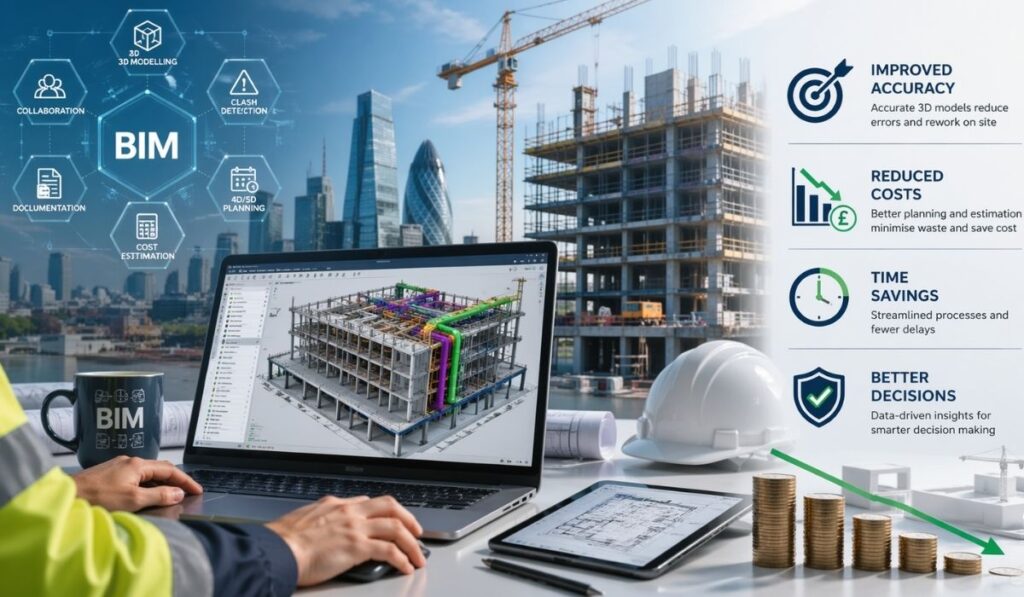
BIM Services are transforming the UK construction industry by improving project accuracy, enhancing collaboration, and reducing overall construction costs. As building projects become more technically demanding, traditional workflows often struggle to manage complex data, coordination challenges, and evolving project requirements. Consequently, construction companies across the UK are increasingly adopting Building Information Modelling (BIM) to streamline design, planning, and project delivery processes.
Through intelligent 3D modelling, real-time collaboration, and accurate digital data, BIM enables architects, engineers, contractors, and facility managers to work more efficiently throughout the entire project lifecycle. In addition, these digital workflows help identify clashes before construction begins, reduce material waste, minimise costly rework, and improve communication between multiple stakeholders. As a result, projects can be delivered faster, more accurately, and with better cost control.
From infrastructure and utilities to commercial and industrial developments, BIM-driven solutions continue to reshape modern construction practices throughout the UK. Companies such as BIMTek provide advanced surveying, laser scanning, and digital modelling services that support smarter, more efficient, and highly coordinated project delivery.
What Are BIM Services?
BIM Services refer to a range of digital construction solutions that use intelligent 3D models and integrated project data to improve planning, design, construction, and facility management. Unlike traditional 2D drafting methods, BIM creates a collaborative digital environment where architects, engineers, contractors, and stakeholders can access accurate and up-to-date project information in real time.
In the UK construction industry, BIM has become an essential tool for delivering projects with greater efficiency and precision. By combining geometry, technical specifications, scheduling data, and operational information into a single coordinated model, BIM supports better decision-making throughout every stage of a project lifecycle. Consequently, teams can identify design conflicts early, reduce delays, and improve communication between multiple disciplines.
Modern BIM Services cover far more than simple 3D modelling. They include clash detection, construction sequencing, point cloud modelling, laser scanning integration, digital asset management, and project coordination. Additionally, many UK construction projects now use BIM to support sustainability goals, improve health and safety planning, and optimise long-term building maintenance.
One of the major advantages of BIM is its ability to centralise data from different project teams into a shared digital environment. As a result, project stakeholders can collaborate more effectively while reducing the risk of costly errors and duplicated work. This coordinated approach is particularly valuable for large infrastructure, industrial, and utility projects where accuracy and efficient communication are critical.
Companies such as BIMTek provide advanced BIM, laser scanning, and surveying solutions that help construction professionals improve project visibility, coordination, and operational efficiency across complex developments.
Why Accuracy Matters in Construction Projects
Accuracy plays a critical role in every stage of a construction project, from initial design and planning to installation and long-term asset management. Even small errors in measurements, coordination, or documentation can lead to significant delays, material waste, safety concerns, and unexpected costs. As construction projects across the UK become increasingly complex, maintaining precision throughout the project lifecycle has become more important than ever.
Traditional construction methods often rely on disconnected drawings, manual data handling, and limited collaboration between disciplines. Consequently, teams may encounter design clashes, inconsistent information, and communication gaps that result in costly rework during construction. In many cases, inaccurate site measurements or outdated drawings can also affect procurement schedules, installation quality, and overall project timelines.
BIM Services help address these challenges by creating a coordinated digital environment where all project stakeholders can work from accurate, real-time information. Through intelligent 3D models and shared project data, teams can identify potential issues before physical construction begins. As a result, project managers can reduce errors, improve decision-making, and maintain greater control over budgets and schedules.
In addition, digital coordination improves collaboration between architects, engineers, surveyors, contractors, and facility managers. Since all project information is connected within a centralised model, updates can be shared instantly across teams, reducing misunderstandings and improving workflow efficiency. This level of coordination is particularly valuable for infrastructure, industrial, and utility projects where multiple systems must integrate seamlessly.
Modern surveying technologies such as laser scanning, LiDAR, and drone mapping also contribute to higher construction accuracy by capturing highly detailed site data. When integrated into BIM workflows, these technologies provide precise digital representations of existing conditions, helping teams plan installations more effectively while reducing onsite risks and costly modifications.
Companies like BIMTek use advanced BIM and surveying solutions to help UK construction projects achieve greater precision, improved coordination, and more reliable project outcomes.
How BIM Services Improve Construction Accuracy
BIM Services improve construction accuracy by creating a highly coordinated digital environment where project teams can plan, visualise, and manage every aspect of a development before physical work begins. By integrating intelligent 3D models with real-time project data, BIM allows architects, engineers, contractors, and surveyors to work from a single source of accurate information. Consequently, construction teams can reduce errors, improve collaboration, and deliver projects more efficiently.
Enhanced 3D Visualisation and Planning
One of the biggest advantages of BIM Services is the ability to create detailed 3D visualisations of a project. Unlike traditional 2D drawings, BIM models provide a realistic representation of structures, systems, and layouts, making it easier for stakeholders to understand project requirements. As a result, teams can identify design inconsistencies and spatial conflicts much earlier in the planning stage.
Improved visualisation also supports better decision-making throughout the construction lifecycle. Contractors can assess installation sequences, evaluate accessibility, and plan site logistics more accurately before onsite activities begin. Additionally, clients and project managers gain clearer insights into project progress and expected outcomes.
Clash Detection and Coordination
Construction projects often involve multiple disciplines working simultaneously, including structural, mechanical, electrical, and plumbing systems. Without proper coordination, these systems can conflict with one another, leading to costly delays and rework during installation.
BIM Services solve this challenge through advanced clash detection tools that identify potential conflicts before construction begins. By analysing coordinated 3D models, project teams can detect overlaps, clearance issues, and design inconsistencies early in the process. Consequently, contractors can resolve problems digitally rather than making expensive onsite modifications later.
This proactive coordination significantly improves installation accuracy while reducing project risks and downtime.
Accurate Site Data Through Laser Scanning and LiDAR
Modern BIM workflows often integrate laser scanning, LiDAR technology, and drone surveys to capture highly accurate site information. These technologies create detailed point cloud data that reflects real-world site conditions with exceptional precision.
When incorporated into BIM models, this data allows engineers and designers to work from reliable measurements instead of outdated drawings or manual surveys. As a result, projects involving existing buildings, industrial facilities, or infrastructure upgrades can achieve much higher levels of accuracy.
In addition, accurate digital site data reduces the likelihood of dimensional errors, installation conflicts, and unexpected construction changes.
Improved Collaboration Across Project Teams
Effective communication is essential for construction accuracy, particularly on large and technically complex projects. BIM Services improve collaboration by centralising all project information within a shared digital model that can be accessed by all stakeholders.
Because updates are made in real time, architects, engineers, contractors, and consultants can work from the latest project information at all times. This reduces misunderstandings, duplicated work, and inconsistent documentation. Furthermore, faster communication helps improve project coordination and supports more efficient decision-making.
Better Prefabrication and Offsite Manufacturing
BIM-driven accuracy also supports the growing use of prefabrication and offsite manufacturing in UK construction projects. Since BIM models contain highly detailed dimensions and technical specifications, manufacturers can produce components with greater precision before delivery to site.
This approach reduces material waste, shortens installation time, and improves overall construction quality. Additionally, accurate prefabrication minimises onsite adjustments and helps maintain tighter project schedules.
Companies such as BIMTek combine advanced BIM workflows with laser scanning and surveying technologies to help UK construction projects achieve greater precision, improved coordination, and more efficient delivery outcomes.
How BIM Services Reduce Construction Costs
In addition to improving project accuracy, BIM Services play a major role in reducing overall construction costs across the UK construction industry. By improving planning, coordination, and resource management, BIM helps minimise expensive errors, reduce project delays, and optimise the use of labour and materials. Consequently, construction companies can complete projects more efficiently while maintaining better control over budgets and timelines.
Reducing Rework and Material Waste
One of the most significant causes of increased construction costs is rework resulting from design conflicts, inaccurate measurements, or poor coordination between project teams. Traditional workflows often identify these issues only after construction has started, leading to costly modifications and delays.
BIM Services help eliminate many of these problems by detecting clashes and inconsistencies during the design phase. Through coordinated 3D modelling and real-time collaboration, teams can resolve issues digitally before materials are ordered or installation begins. As a result, contractors can significantly reduce waste, avoid unnecessary demolition, and lower the cost of corrective work.
In addition, accurate material quantification within BIM models improves procurement planning, helping teams order the right quantities of materials and reduce surplus inventory.
Faster Project Delivery and Improved Scheduling
Delays can have a major financial impact on construction projects, especially for large infrastructure and industrial developments. BIM Services improve scheduling accuracy by allowing project teams to visualise construction sequences and coordinate workflows more effectively.
Using 4D BIM modelling, contractors can link project schedules with digital models to simulate construction activities before onsite work starts. Consequently, teams can identify potential delays, optimise sequencing, and improve resource allocation throughout the project lifecycle.
Improved scheduling also reduces downtime between trades, minimises disruption onsite, and helps projects stay on track. As a result, companies can reduce labour costs and avoid financial penalties associated with project overruns.
Improved Collaboration Reduces Operational Inefficiencies
Poor communication between project stakeholders can lead to duplicated work, conflicting information, and inefficient workflows. BIM Services create a shared digital environment where all teams can access the latest project data in real time.
Because everyone works from the same coordinated model, misunderstandings and document inconsistencies are significantly reduced. Additionally, faster communication improves decision-making and helps resolve issues more efficiently. This streamlined collaboration ultimately lowers administrative costs and improves overall project productivity.
Supporting Offsite Fabrication and Modular Construction
The increasing use of offsite manufacturing and modular construction in the UK is closely linked to the adoption of BIM workflows. Since BIM models provide highly accurate dimensions and technical specifications, manufacturers can produce prefabricated components with greater precision.
This reduces onsite labour requirements, minimises material waste, and shortens installation times. Furthermore, prefabrication improves quality control because many components are produced in controlled factory environments rather than unpredictable construction sites.
As a result, projects benefit from lower labour costs, improved safety, and faster completion times.
Lower Long-Term Operational and Maintenance Costs
BIM Services continue to deliver value even after construction is complete. Digital models contain detailed asset information that supports facility management, maintenance planning, and future renovations.
Building owners and facility managers can use BIM data to monitor asset performance, schedule maintenance activities, and access important technical information more efficiently. Consequently, operational costs can be reduced over the long term while improving the lifespan and performance of building systems.
Companies such as BIMTek help UK construction and infrastructure projects reduce costs through advanced BIM coordination, laser scanning, and intelligent digital modelling solutions that improve efficiency across every project stage.
The Growing Importance of BIM Services in the UK Construction Industry
The adoption of BIM Services continues to grow rapidly across the UK construction sector as organisations seek more efficient, accurate, and sustainable ways to deliver projects. With increasing pressure to reduce costs, improve collaboration, and meet strict regulatory requirements, digital construction technologies have become essential for modern infrastructure and building development.
In recent years, the UK government and major industry bodies have strongly encouraged the use of BIM to improve project delivery standards across both public and private sectors. Consequently, construction companies, engineering consultants, and asset owners are investing heavily in digital workflows that support smarter planning, improved coordination, and long-term operational efficiency.
Government Support and Industry Standards
The UK has been one of the leading countries in driving BIM adoption within the construction industry. Government initiatives promoting collaborative digital construction have encouraged organisations to modernise traditional workflows and improve project transparency.
BIM standards and frameworks help create consistency across projects by ensuring that all stakeholders follow structured data management and coordination processes. As a result, project teams can collaborate more effectively while reducing risks associated with inaccurate documentation and fragmented communication.
In addition, digital construction strategies support broader UK goals related to sustainability, carbon reduction, and infrastructure modernisation. BIM allows project teams to analyse building performance, optimise material usage, and improve energy efficiency throughout the asset lifecycle.
Increasing Demand Across Multiple Sectors
BIM Services are now widely used across a variety of UK industries, including infrastructure, utilities, commercial construction, manufacturing, healthcare, transportation, and industrial facilities. Each sector benefits from the ability to improve project coordination, manage complex systems, and reduce operational inefficiencies.
For example, water treatment plants and utility infrastructure projects often involve highly detailed mechanical, electrical, and process systems that require precise coordination. BIM workflows help engineers and contractors visualise these systems in advance, reducing installation conflicts and improving maintenance accessibility.
Similarly, commercial and industrial construction projects use BIM to streamline planning, support modular construction, and improve collaboration between architects, engineers, and contractors.
Supporting Infrastructure Upgrades and Retrofit Projects
The UK construction industry is increasingly focused on upgrading existing infrastructure and improving ageing facilities. However, retrofit and refurbishment projects often present unique challenges due to limited documentation and complex existing conditions.
BIM Services combined with laser scanning and LiDAR technology provide accurate digital representations of existing assets, enabling project teams to plan modifications more effectively. Consequently, construction companies can reduce uncertainty, improve installation accuracy, and minimise disruption during upgrade works.
This capability is particularly valuable for sectors such as utilities, manufacturing, and transportation where maintaining operational continuity is critical.
Driving Innovation Through Digital Construction
As construction technology continues to evolve, BIM is becoming the foundation for more advanced digital solutions such as digital twins, smart asset management, and AI-driven project analysis. These technologies allow organisations to monitor building performance in real time, predict maintenance requirements, and improve operational decision-making.
Furthermore, the integration of drones, laser scanning, cloud collaboration platforms, and automated workflows is helping construction teams achieve higher levels of efficiency and project visibility than ever before.
Companies such as BIMTek support this digital transformation by providing advanced BIM coordination, surveying, and modelling solutions tailored to the evolving needs of the UK construction and infrastructure sectors.
Real-World Applications of BIM Services in UK Construction
The practical use of BIM Services extends across a wide range of construction and infrastructure projects throughout the UK. From complex industrial facilities to major infrastructure upgrades, BIM-driven workflows help project teams improve coordination, reduce risk, and achieve more efficient project delivery. As construction demands continue to evolve, organisations are increasingly relying on digital modelling and intelligent data management to handle technically challenging environments with greater accuracy.
Water and Utility Infrastructure Projects
Water treatment plants, pumping stations, and utility infrastructure projects often involve highly complex mechanical, electrical, and process systems that require careful coordination during both design and installation. BIM Services help engineers visualise these systems within a detailed 3D environment before construction begins.
By integrating laser scanning and point cloud data into BIM models, teams can accurately capture existing site conditions and plan installations with minimal disruption to live operations. Consequently, contractors can reduce downtime, improve safety, and avoid costly clashes between new and existing infrastructure.
In addition, BIM supports long-term asset management by providing accurate digital records for maintenance and future upgrades.
Commercial Construction and Building Developments
Commercial construction projects often involve multiple contractors, consultants, and stakeholders working simultaneously across different disciplines. Without proper coordination, communication gaps and design conflicts can quickly affect project timelines and budgets.
BIM Services improve collaboration by providing a shared digital model that centralises all project information. Architects, engineers, structural designers, and contractors can coordinate more effectively while identifying potential issues early in the design stage.
Furthermore, BIM enables project managers to monitor construction progress more accurately, improve scheduling efficiency, and optimise resource allocation throughout the project lifecycle.
Industrial and Manufacturing Facilities
Industrial construction projects frequently require precise integration of structural elements, process equipment, pipework, and electrical systems within restricted operational spaces. BIM workflows help project teams visualise complex layouts while improving installation planning and sequencing.
Laser scanning technology is especially valuable in existing industrial facilities where accurate site measurements are critical for retrofit or expansion projects. By combining scanning data with intelligent 3D modelling, teams can minimise installation conflicts and reduce operational disruption during construction activities.
This approach also supports prefabrication and modular construction methods, helping industrial projects improve quality control and reduce onsite labour requirements.
Infrastructure Retrofit and Refurbishment Projects
Many UK infrastructure assets require ongoing upgrades and refurbishment to meet modern operational and environmental standards. However, retrofit projects can be challenging due to outdated documentation, hidden structural conditions, and limited site accessibility.
BIM Services help overcome these challenges by creating highly accurate digital representations of existing assets using LiDAR, drone surveys, and laser scanning technology. As a result, engineers can plan modifications with greater confidence while reducing the risk of unexpected onsite issues.
Additionally, digital coordination allows project teams to test construction scenarios virtually before work begins, helping minimise delays and improve overall project efficiency.
Supporting Sustainable Construction Practices
Sustainability has become a major focus within the UK construction industry, and BIM Services play an important role in supporting environmentally responsible project delivery. Through accurate modelling and data analysis, BIM helps teams optimise material usage, reduce waste, and improve energy efficiency.
Construction companies can also use BIM to evaluate building performance, assess carbon impacts, and support sustainable design strategies during early project planning stages. Consequently, projects can achieve better environmental performance while maintaining cost efficiency and operational effectiveness.
Companies such as BIMTek deliver advanced BIM, surveying, and digital engineering solutions that support accurate coordination and efficient project execution across infrastructure, industrial, and commercial construction sectors in the UK.
Key Benefits of BIM Services for UK Construction Companies
BIM Services offer a wide range of advantages for construction companies operating across the UK. By integrating intelligent digital models, accurate site data, and collaborative workflows, BIM enhances project delivery, reduces costs, and improves overall operational efficiency. The benefits extend across design, construction, and long-term facility management, making BIM an indispensable tool for modern construction projects.
Improved Construction Accuracy
One of the most significant benefits of BIM Services is the ability to achieve higher levels of accuracy throughout the project lifecycle. By using detailed 3D models and integrating real-world site data from laser scanning or LiDAR surveys, project teams can identify design conflicts early, reduce measurement errors, and minimise costly rework onsite. This ensures that installations are precise and compliant with technical specifications.
Reduced Project Risks
BIM Services provide comprehensive visibility into project workflows, enabling stakeholders to identify potential issues before construction begins. By detecting clashes, coordinating complex systems, and simulating construction sequences, BIM reduces risks associated with delays, design errors, and miscommunication between disciplines.
Enhanced Collaboration and Communication
Centralised BIM models allow architects, engineers, contractors, and clients to work from a single source of truth. Real-time updates and coordinated information improve communication, reduce misunderstandings, and streamline decision-making across all project teams. This collaborative approach is especially valuable on large, multi-disciplinary projects where multiple teams must work in harmony.
Faster Project Completion
By enabling accurate planning, sequencing, and clash-free designs, BIM Services accelerate construction timelines. Prefabrication and modular construction, supported by precise BIM models, further reduce onsite installation time, allowing projects to be completed faster and more efficiently.
Lower Operational and Maintenance Costs
BIM models provide a digital record of building systems and assets, which can be used for long-term facility management. By facilitating maintenance planning, monitoring asset performance, and supporting renovations or retrofits, BIM helps reduce operational costs and extends the lifecycle of infrastructure and buildings.
Sustainability and Resource Efficiency
BIM Services contribute to sustainable construction practices by optimising material usage, reducing waste, and improving energy efficiency. Accurate modelling and data analysis allow teams to make informed decisions that minimise environmental impacts while maintaining cost-effectiveness.
Companies such as BIMTek deliver these benefits to UK construction projects through advanced BIM coordination, surveying, and 3D modelling solutions that improve accuracy, efficiency, and cost management across the entire project lifecycle.
Challenges in BIM Adoption and How to Overcome Them
Although BIM Services offer substantial advantages for the UK construction industry, some organisations still face challenges when implementing digital construction workflows. These obstacles can range from technical limitations and training requirements to cost concerns and resistance to operational change. However, with the right strategy and experienced BIM partners, companies can successfully overcome these barriers and achieve long-term benefits.
Initial Investment and Software Costs
One of the most common concerns surrounding BIM adoption is the upfront investment required for software, hardware, and employee training. Smaller construction firms may initially view BIM implementation as an expensive transition compared to traditional workflows.
However, while the initial costs can be significant, BIM Services often deliver long-term savings through reduced rework, improved efficiency, and better project coordination. Consequently, many organisations recover their investment through lower operational costs and improved project delivery performance over time.
Training and Skill Development
Effective BIM implementation requires skilled professionals who understand digital modelling, data coordination, and collaborative workflows. For companies transitioning from conventional design methods, this can create a temporary skills gap within project teams.
To address this challenge, many UK construction companies invest in ongoing staff training and professional development programmes. In addition, working with experienced BIM consultants and digital engineering specialists helps organisations integrate BIM workflows more effectively while building internal expertise.
As BIM adoption continues to grow across the industry, digital construction skills are becoming increasingly valuable for engineers, architects, surveyors, and project managers.
Managing Large Volumes of Project Data
BIM models contain extensive project information, including geometry, specifications, schedules, and asset data. Without proper management systems, handling this volume of information can become complex and difficult to coordinate across multiple teams.
Implementing structured data management standards and common data environments (CDEs) helps ensure consistency, accessibility, and version control throughout the project lifecycle. As a result, project teams can maintain accurate information while improving collaboration and reducing documentation errors.
Resistance to Process Changes
Some organisations may resist adopting BIM Services due to familiarity with traditional workflows or concerns about changing established operational processes. However, relying solely on conventional methods can limit efficiency, collaboration, and project visibility in increasingly complex construction environments.
Successful BIM adoption often depends on creating a clear digital transformation strategy and demonstrating the long-term value of collaborative workflows. By gradually integrating BIM into projects and highlighting measurable improvements in accuracy and cost control, companies can build confidence among stakeholders and project teams.
Integration with Existing Systems and Projects
Many construction organisations manage a combination of legacy systems, older infrastructure, and ongoing projects that may not initially align with modern BIM workflows. Integrating BIM into these environments can require careful planning and coordination.
Technologies such as laser scanning, LiDAR, and point cloud modelling help bridge this gap by creating accurate digital representations of existing assets. Consequently, teams can integrate older facilities into BIM workflows more effectively while improving planning and coordination for refurbishment or expansion projects.
Choosing the Right BIM Partner
Working with experienced BIM specialists is essential for achieving successful project outcomes. Professional BIM providers can help organisations develop efficient workflows, maintain data accuracy, and implement digital coordination strategies tailored to specific project requirements.
Companies such as BIMTek support UK construction projects with advanced BIM coordination, laser scanning, and digital engineering expertise that helps businesses overcome implementation challenges and maximise the value of digital construction technologies.
Future Trends in BIM Services
As digital transformation continues to reshape the UK construction industry, BIM Services are evolving far beyond traditional 3D modelling and project coordination. Emerging technologies such as artificial intelligence, digital twins, automation, and advanced surveying solutions are expanding the capabilities of BIM and creating smarter, more connected construction environments. Consequently, organisations that invest in modern BIM workflows are better positioned to improve efficiency, reduce costs, and remain competitive in the rapidly evolving construction sector.
Artificial Intelligence and Automation in BIM
Artificial intelligence (AI) is beginning to play a major role in enhancing BIM workflows and improving construction decision-making. AI-driven systems can analyse large volumes of project data to identify design risks, optimise construction sequencing, and predict potential delays before they occur.
Automated clash detection and rule-based model checking also help reduce manual coordination tasks while improving overall project accuracy. As a result, construction teams can spend less time resolving design conflicts and more time focusing on project delivery and innovation.
In the future, AI-powered BIM platforms are expected to support predictive maintenance, automated reporting, and smarter resource allocation across construction projects.
Growth of Digital Twins
Digital twin technology is becoming increasingly important within infrastructure, industrial, and commercial construction projects throughout the UK. A digital twin is a live digital representation of a physical asset that continuously updates using real-time operational data.
When combined with BIM Services, digital twins allow building owners and facility managers to monitor asset performance, analyse operational efficiency, and improve maintenance planning throughout the lifecycle of a structure. Consequently, organisations can make more informed decisions while reducing downtime and operational costs.
Digital twins are especially valuable for complex facilities such as water treatment plants, industrial sites, transport infrastructure, and smart buildings where ongoing monitoring and optimisation are critical.
Integration with Advanced Surveying Technologies
Modern BIM workflows are becoming increasingly integrated with advanced surveying technologies such as LiDAR, drone mapping, laser scanning, and photogrammetry. These technologies provide highly accurate site data that improves modelling precision and project coordination.
Drone surveys, in particular, allow construction teams to capture large-scale site information quickly and safely, even in difficult-to-access environments. When combined with BIM models, this data supports more accurate planning, progress monitoring, and asset management.
Additionally, real-time site capture technologies are helping project teams maintain up-to-date digital models throughout active construction phases.
Cloud Collaboration and Connected Workflows
Cloud-based BIM platforms are improving collaboration between geographically distributed project teams by enabling real-time access to project information from virtually any location. This connected approach allows architects, engineers, contractors, and clients to coordinate more efficiently while reducing communication delays.
As cloud technology continues to advance, BIM workflows are expected to become even more integrated with project management systems, procurement platforms, and operational monitoring tools. Consequently, organisations will benefit from improved transparency, faster decision-making, and more streamlined construction processes.
Sustainable and Smart Construction Practices
Sustainability remains a major priority within the UK construction industry, and BIM Services are playing an increasingly important role in supporting environmentally responsible building practices. Advanced BIM analysis tools allow project teams to evaluate energy performance, optimise material usage, and reduce carbon emissions during both construction and operation.
Future BIM technologies are also expected to support smart buildings equipped with connected sensors, automated systems, and real-time performance monitoring. This integration between BIM and smart infrastructure will help organisations improve operational efficiency while supporting long-term sustainability goals.
Companies such as BIMTek continue to support the future of digital construction through advanced BIM coordination, laser scanning, and intelligent surveying solutions that help UK projects adopt smarter, more efficient, and future-ready workflows.
Conclusion
BIM Services have become a vital part of modern construction across the UK, helping organisations improve project accuracy, reduce operational risks, and control construction costs more effectively. As projects continue to grow in complexity, traditional workflows often struggle to deliver the level of coordination and precision required for efficient project execution. Consequently, more construction companies, infrastructure providers, and engineering teams are adopting BIM-driven processes to streamline project delivery and improve long-term asset performance.
Through intelligent 3D modelling, clash detection, laser scanning integration, and collaborative digital workflows, BIM allows stakeholders to identify problems before construction begins, reducing costly rework and minimising project delays. In addition, BIM supports better communication between architects, engineers, contractors, and facility managers, creating a more connected and efficient construction environment.
The benefits of BIM Services extend beyond the construction phase. Accurate digital models and asset data continue to support maintenance planning, facility management, refurbishment projects, and future infrastructure upgrades. Furthermore, the integration of emerging technologies such as AI, digital twins, drone surveying, and cloud collaboration platforms is shaping the future of smarter and more sustainable construction practices across the UK.
As the industry increasingly focuses on efficiency, sustainability, and digital transformation, BIM will continue to play a critical role in improving construction outcomes and supporting long-term operational success. Companies such as BIMTek provide advanced BIM coordination, surveying, and digital engineering solutions that help UK construction projects achieve greater accuracy, improved collaboration, and more cost-effective project delivery.
